Route & what to see

|
A Walthamstow Village Walk Route & what to see |
|
london-footprints.co.uk |
A circular walk of 1¾ miles around the conservation areas of Walthamstow Village and Orford Road. The museum is worth visiting (see below). An alternative route beyond the church to Lloyd Park and the William Morris Galley via civic buildings is available [click here]
Begin at Walthamstow Central
Station (National Rail or Victoria line).
The station, opened by the Great Eastern Railway in 1870,
was originally called Hoe Street. The Victoria line was extended
to Walthamstow in 1968.
Exit into Selbourne Road and
go right. Cross the main road into St Mary Road which becomes a
pedestrian path
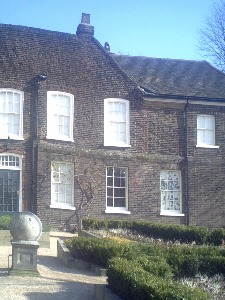
On the right is the former Vestry House, built in 1730. An
extension accommodated the parish workhouse (until the 1830s)
later becoming a police station (until 1870), armoury (until
1891) then builder's yard (until 1933). After the Vestry
successors, the Local Board, moved to Orford Road in the 1870s
the vestry house was used by the Walthamstow Literary &
Scientific Institute (1882-92) after which it became a private
house. The last owner leased it to the local council in 1930 to
house a local museum. In 2001 the garden, originally used by the
workhouse, was bought back into use and 3 cottages on the site
were redesigned as an extension to the museum. It is open Wed -
Sun 10-5 and admission is free. Outside is a capital from
Smirke's GPO building in the City (demolished in 1912). Opposite
the museum is the former National School, built in 1819 for 200
pupils. It was enlarged in 1825 and used until 1906. It remained
in use as a Sunday School and parish rooms until 1920 when it was
sold to the Senior Scouts Association. It has been a National
Spiritualist Church since 1928. Adjacent is a building which
housed the fire engine (see plaque). Across from this are Squires
Almshouses built in 1795 for six poor widows of the parish (see
plaque). The building was modernised internally in the late 20th
century and now houses four almspeople.
Go right along Vestry Road
The road crosses the railway then on the left is number 5, the
former school house of 1866 in Jacobean style by William
Wittington. Beyond this is the former Post Office Sorting Office
built in 1903 and decorated with terracotta and Dutch gables. The
playground opposite was sited on part of Church Common.
At the end of the road turn
left along East Avenue to Orford Road
On the opposite corner is Orford House, an early 19th century
neo-classical villa, originally the home of John Cass.
Go left along Orford Road
These were the principle shops in the Victorian era. Notice the
attractive fascia of the Eden Road corner shop.
Go right into Eden Road
This was developed by the Local Board of Health in 1862 and
has examples of 'model cottages' which cost £12 - £19 !
Return to Orford Road
Opposite is the former National School, built in 1866 to
supplement the school already seen. From 1949-1977 the buildings
housed the pathology department of the Connaught Hospital and it
is now used as the Asian Centre. Along from this is the
Italianate Old Town Hall of 1876, extended in 1890-1. This was
added to the front of a public hall of 1866 which was replaced by
housing in 1994. With the opening of the new Town Hall in 1941
the building became an office for the Ministry of Food, part of
the Connaught Hospital (1959-77) then Waltham Forest College (to
1986).
Follow Orford Road round to
the left crossing the railway again
The Nag's Head is a Victorian rebuild of an earlier inn. At the
corner with Church Lane is the Ancient House. This 15th century
timber framed 'Hall' house had shop fronts added in the 19th
century. It has undergone restoration. Number 10 Church Lane is a
detatched late Georgian house with outbuildings (c1830) occupied
by the builder Anthony Storey Reed. Opposte is a listed example
of a Penfold Hexagonal postbox (notice the small slot).
From Church Lane go right
into Bishops Close
The Chestnuts is an early 19th century villa, home at one time to
the Headmaster of Monoux School and some of its boarders. It has
now been converted to flats.
Return to and continue along
Church Lane. At the end take Vinegar Alley on the left heading
back to the village
On the left is the church of St Marys, an ancient foundation
which has undergone many changes. It was granted to Holy Trinity
Priory in Aldgate until the Reformation. On the opposite side of
the alley the Monoux Almshouses and Grammar School were founded
in 1527 by George Monoux, a city merchant and Lord Mayor. The
west range provided 6 single rooms with a schoolroom above. The
cross wing housed the schoolmaster, parish clerk & alms
priest and the east range provided 7 more rooms. The eastern end
was rebuilt in 1730 and the western end in 1955, following WWII
bomb damage. The accommodation was extended and modernised in the
1990s. At the end of the alley is the Welcome Centre, formerly an
infants school built in 1828. The graveyard in front has several
grand tombs indicating Walthamstow's properous past. It was also
the site of mass burials for the Black Death and Plague.
Follow Church Hill to the
right
The High School for Girls was designed in a neo-Georgian
style by C J Davison in 1911-3. The former church parsonage of
c1890 is now part of the school.
Follow the road to the left
Energy House was designed at electricty showrooms by T F
Cunningham in 1937. At the end of the road are buildings of the
1950s with a clock tower and coat of arms on the corner building.
To the left are cafes, a pub on the corner of Selbourne Road and the railway & bus station. Straight ahead is the High Street with the longest street market in London. From this there are entrances on the left into the Selbourne Walk Shopping Centre. You can also walk through to Selbourne Road and the station. The library, designed by J W Dunford and financed by Andrew Carnegie was built in 1907-9. This now has a new extension. A new cinema complex opened in 2014 as part of the High Street regeneration.
This walk can also be extended with my 3½ mile linear route which finishes at Stamford Hill (national rail or buses). [details]
© london-footprints.co.uk 2012
Reference sources
Leaflets and information on the area available at or from Vestry
House Museum E17 9NH. Tel 020 8509 1917
Walthamstow Historical Society [website]
A walk around Walthamstow is included in 'Village London' by
Andrew Duncan
Buildings of England London 5: East by Cherry, O'Brien &
Pevnser
Exploring East London - [Walthamstow
Village]
[booklist] [places to visit] [almshouses] [walks list]