Additional information

|
Surrey Docks Walk Additional information |
|
london-footprints.co.uk |
[Canada Water] [Canals] [Greenland Dock] [Lavender Pumphouse] [Nelson Dock] [Reference Sources] [Russia Dock Woodland]
INTRODUCTION
Surrey Docks initially developed irregularly under four separate
companies who combined in 1865. It covered an area of 300 acres,
comprising 10 docks/timber ponds and a basin plus a 3 mile long
canal to Peckham. The main import was timber plus grain and
commodities from the West Indies. The docks declined following
war damage and the advent of containerisation. The Port of London
Authority had taken control in 1909 but sold out to Southwark
Council in 1969. Closures took place in 1970-1 and an infilling
programme followed until 1981 when the London Docklands
Development Corporation was given a ten year period (later
extended) of responsibility for the regeneration of the whole of
Docklands.
CANALS
The Grand Surrey Canal of 1801 reached Camberwell Road in 1811-2
with a branch to Peckham opening in 1826. A two-armed dock and
ship lock was built at the river end in 1804-7. The canal was
widened into the Russia Dock in 1898 in conjuction with the
enlargement of neighbouring Greenland Dock. A canal office of the
1890s remains on Rope Walk. In 1855-60 a new entrance lock and
basin was constructed with Albion Dock to the west. The system
closed in 1971 and Surrey Water was created from the Surrey
Basin. A newly constructed canal follows the position of the
former Albion Dock between Surrey & Canada Waters and retains
its quay edge. It is crossed by several bridges and surrounded by
distinctive housing developments.
GREENLAND
DOCK
This was originally the Howland Great Wet Dock opened around 1696
as a 10 acre facility for 120 merchant ships. Edged with polar
trees it provided a haven against winter gales & river ice,
for repairs to be carried out and made theft of cargo more
difficult. From 1763 it was renamed and became a centre for the
whaling trade until 1809 when it became an import dock. It was
enlarged to 22 acres in 1894-1904 and now serves as a water
sports centre. The entrance lock designed by Sir John Wolfe Barry
in 1904 has been preserved with its original features although it
is now unused. The bascule bridge at the west end allowed ships
access to Surrey Commercial Dock from Greenland Dock. Originally
installed on Deptford Creek in 1955 it was moved in 1959.
RUSSIA
DOCK WOODLAND
The 34 acre woodland was created in 1980 in the former dock
basin. Within the park are remnants of entrance depth gauges,
canalsides with bollards & mooring chains and former crane
tracks. A compass set in the path depicts the area's former
trade. A central motif is of a Southwark Sparrow that was at one
time the local newspaper and a council logo. Stave Hill was
created by the LDDC in 1985 from industrial spoil. A bronze
relief map by Michael Rizzello, which fills with rainwater, shows
the docks as they were in 1896.
|
LAVENDER PUMPHOUSE Lavender Lock was constructed in 1863 to provide access to ponds where timber was stored so as not to dry out and split. The lock was linked by a small drawbridge to the pumphouse (built in 1929) which enabled water levels to be regulated. The building was refurbished in 1989 to serve as an educational museum (now closed). The Nature Park is maintained by TRUE and has been awarded a Green Penant.  |
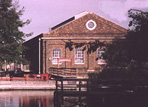
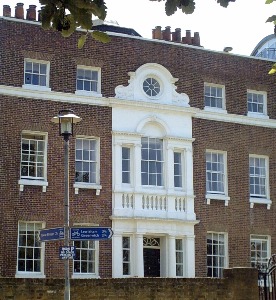
| NELSON DOCK Nelson Dockyard was used for shipbuilding from the 17th century producing clippers, war ships and steam ships. A dry dock was built around 1790. In 1870 it changed to ship repairs, closing in 1968. Nelson House (pictured right) was built for one of the shipyard owners and is Grade II listed. The adjoining Engine House (pictured in header) was constructed in 1850 and provided hydraulic power for hauling ships out of the river. The present machinery dates from 1900. |
 |
CANADA
WATER
This occupies about a third of the former Canada Dock of 1874-6
the remainder having been developed by Tescos as a retail centre
in 1988. It has a fresh water ecology replenished by excess water
from Surrey Docks Station. There is a bronze statue by Philip
Bews of the Deal Porters. These were a special class of docker,
virtually confined to Surrey Docks, who carried loose sawn timber
on their shoulders and heads stacking it up to 50' high. The Dock
Manager's Office was in use 1887-1969 and was restored by the
LDDC. Canada Water Station on the Jubilee line was opened in
1998. The library by Piers Gough opened in November 2011 and is
worth a visit [pix].
REFERENCE
SOURCES
London Docklands - an Architectural Guide by Williamson &
Pevsner
Discover Docklands by S K Al Naib
Discover Deptford & Lewisham by Darrell Spurgeon
Find out more at the Museum of London Docklands [website]
london-footprints.co.uk 2013
[route & what to see] [walks list]
wksurreydocksadd