Route & what to see

|
A Knightsbridge & Hyde Park Walk Route & what to see |
|
london-footprints.co.uk |
Areas of London with grand houses also had mews and service areas nearby. Now the houses tend to be used as embassies & offices and the former provinces of the servants are smart (if small) residences. A large shop and a small pub are also featured. The circular walk takes in a number of monuments and memorials. There is the opportunity to visit Apsley House and the Wellington Arch.
This 2½ mile linear walk begins at Hyde Park Corner tube station (Piccadilly line) and finishes at South Kensington. It can be extended into a circular route by returning through Hyde Park. The 3½ mile circular walk passes a number of London's monuments.
Exit by the Lanesborough
Hotel, formerly St George's Hospital, and go left along
Knightsbridge.
The frontage of a disused underground station entrance with
distinctive ox-blood tiles is now incorporated into a hotel.
Go first left through Old
Barrack Yard, through the gate and down steps alongside
the Grenadier pub
The stables, cottages and pub were built in the 1830s and ran
alongside Foot Guard Barracks constructed in 1758. The pub was
used for gambling and a soldier found to be cheating was beaten
and died of his injuries. His ghost haunts the pub and is said to
be particularly active in September!
Go left around Wilton Row
then around Wilton Crescent to the right. At the centre go right
along Wilton Place
St Paul's Church was built in 1840-3 by Thomas Cundy the
younger.
Go left through Kinnerton
Street
This was built in the 1820s as a service road but courts ending
at the Ranelagh Sewer became slums. The Nag's Head probably
served as livery stables. It could claim to be one of London's
smallest pubs although a semi-basement area became a second bar
in the 1970s. It has many genuine curios including two 1930s slot
machines.
At the end go right along
Motcomb Street
On the north side stood the two acre complex of the
Pantechnicon built in 1830. These 'fireproof' warehouses,
stables, wine vaults and carriage houses were almost totally
destroyed by fire in 1874 and only the frontage remains. There
are arcades to either side of this street.
Cross Lowndes Street into
Cadogan Place ahead. Go left along Sloane Street and right
through Hans Street. Go to the right around Hans Place and take
the second exit across into Hans Road.
Houses in this street were rebuilt in 1880s-90s. Number 12 is by
Arthur Mackmurdo and numbers 14-16 by Charles Voysey. On the
right is the Harrods store. The food department is well worth a
visit. Harrods was founded by Henry Charles Harrod, a tea
merchant of Eastcheap, who opened a small grocers in the village
of Knightsbridge in 1849. His son bought and expanded the
business. The building was destroyed by fire in December 1883 but
still managed to fulfill its Christmas orders. In 1889 it became
a limited company and the premises were re-built and extended in
1902-11.
At the end go right along
Brompton Road then left into Lancelot Place.
Harrods former warehouses, which were linked to the main
store by tunnels, have been re-developed for residental use.
Go around Trevor Square and
exit at the NW corner passing through to Trevor Place. Go ahead
along Montpelier Terrace and left through Sterling Street. Go
right along Montpelier Place and left at Montpelier Walk
These houses of 1840-50 were not considered very high class
dwellings until the 1890s.
Go right at Fairholt Street
and right along Rutland Street.
The 30 small cottages built here in 1830 were described as
'mean'. Those that remain back directly onto properties in
Rutland Mews South.
Go through the opening in
the wall ahead and left along Ennismore Street
Notice the Clock House and Ennismore Arms pub on the right
Continue around Ennismore
Gardens Mews.
This passes the grounds of Holy Trinity Church. There are views
of the dome of Brompton Oratory and the top of the V&A Mueum.
For the linear walk go left
at Princes Gardens and through the grounds of Imperial College to
the left into Watts Way. Go right into Exhibition Road. Opposite
is an entrance to South Kensington tube station (Circle, District
& Piccadilly lines).
Admission is free to the Science, Natural History and
V&A Museums and all have cafes.
For the circular walk go
left at Princes Gardens then right along Exhibition Road.
At the end are the premises of the Royal Geographical
Society. There are statues to explorers Ernest Shackleton (by
Jagger) and David Livingstone.
Cross Kensington Road and
enter the park ahead by the Alexandra Gate & Lodge
To the left is a view of the Albert Memorial, restored and
re-gilded by English Heritage.
Continue along West Carriage
Drive
To the left is the Serpentine Gallery (in Kensington Gardens). On
the right the water feature which is a memorial to Diana,
Princess of Wales was opened by the Queen on 6 July 2004
Cross the bridge over the
Serpentine
The bridge was designed by John & George Rennie. The building
ahead was the Powder Magazine used for storing gunpowder.
Originally built in 1764-5 it has had later alterations. It now
houses the Serpentine Sackler Gallery with a restaurant extension
by Zaha Hadid.
Go to the right along the
north bank of the Serpentine
This was created in the 1730s from an existing string of
fishponds. On the opposite bank is the Lido Pavilion of 1930, now
used as a cafe. Further along are two boathouses and on the left
the Norweigan War Memorial, Receiving House plaque and Serpentine
Lodge. At the end is the Dell Restaurant (designed by Patrick
Gwynne).
Take the path to the right
On the corner there is an urn monument to Abbey Spring.
Take the path to the left
(marked with Diana walk plaque)
On the right is the Holocaust Memorial
Continue through the flower
gardens. Detour to the left at the Rose Garden.
The Cavalry Memorial was designed by an army vet.
Head towards Park Lane
52 steel columns commemorate the people killed in the London
terror bombings in July 2005.
Go southwards to the statue
of Achilles
This is a tribute to the Duke of Wellington. Beyond are the Queen
Elizabeth Gates of 1993.
Exit the park by the Apsley
Gate alongside Hyde Park Corner Lodge (park information centre)
to the tube station
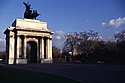
You may like to visit Apsley House - home to the Duke of
Wellington or the Wellington Arch with displays and rooftop views
both in the care of English Heritage. [website]
© london-footprints.co.uk 2013
[additional information] [places to visit] [walks list]