A Hammersmith Walk
Route & what to see

|
|
|
london-footprints.co.uk |
A 4 mile walk from Hammersmith tube station to Ravenscourt Park (District line). The walk can be extended by exploring Ravenscourt Park or returning to Hammersmith Station.
Follow signs to the Apollo
(via subway).
The Hammersmith Apollo was built as the Gaumont Palace
(seating 3560) by Robert Crombie in 1932. This Grade II* listed
building is one of the few to retain its working cinema organ.
The Ark is a prominent building designed by Ralph Erskine in
1992. Hammersmith & Fulham Archives are located in The Lilla
Huset building which was part of the Ark development (limited
opening by appointment).
Go along Fulham Palace Road
There are buildings of the Guinness Trust to the left and
Peabody Building opposite.
Right into Chancellors Road
then walk through Frank Banfield Park to the left into Playfair
Street.
This open space, originally named Chancellors Park, was created
as part of the housing clearance of Elmdale and Playfair Streets
in 1974. Landscaping began in the summer of 1975 and later that
year the park was renamed in honour of Frank Banfield, Mayor of
Fulham, who died in March 1970 after a lifetime of public
service. The park was extended in 1979-80 across Distillery Lane
to Chancellors Road. In 2008, the park underwent a major
transformation. This latest refurbishment has modernised the site
and provided attractive facilities for the local community
through improved landscaping and reconfiguration of the site
entrances and boundary.
Left at Winslow Road. Cross
Fulham Palace Road and go right. Go through the first gates of
Charing Cross Hospital and bear left through the garden.
Maggie's Centre, designed by Lord Rogers partnership, opened on
29 April 2008. It is an uplifting, non-institutional space where
people with cancer, their family and friends can access the
support they need. The centre is open from 9am to 5pm
Monday to Friday. Building on the passion for landscape
architecture of the founder, Maggie Keswick Jencks, Maggie’s
London is surrounded by a specially designed garden and series of
intimate internal courtyards by leading landscape designer Dan
Pearson. [website]
Walk to the right of the
building through the car park into Dunstans Road and go right.
Charing Cross Hospital was built 1969-73 on the site of
Fulham Infirmary, vacating its central London site. The William
Morris Academy occupies a former school. In the corner (No. 17)
is a former house and studio designed by CFA Voysey for WEF
Britten in 1891 which is now the Hungarian Reformed Church. [pix]
At the end go right along
Margravine Gardens
From here there is a view of the rear of LAMDA, Colet House
and St Paul's Studios. On the right is Margravine (Hammersmith)
Cemetery, opened in 1869. Over 89,000 burials took place but many
were laid under grass in the 1950s to create a park. Three
entrance lodges and the non-conformist chapel remain.
Left into Palliser Road
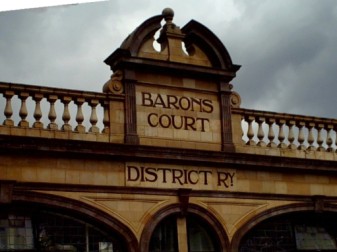
Barons Court Station has attractive tilework of 1905 (see
plaque on corner).
Cross Talgarth Road and look
back.
St Paul's Studios were designed in 1891 by Frederick Wheeler
for 'bachelor artists'. Number 151 is Colet House of 1885,
originally art studios, later an annexe to the Royal Ballet
School and now home to The Study Society. Beyond this is LAMDA.
Go along Gliddon Road
The Hammersmith & West London College was built on the
site of St Paul's School. Barons Keep is a 1930s development.
Continue along Edith Road.
St Mary's church was built in 1814 as a chapel of ease and
enlarged in 1884. It was destroyed by a flying bomb in 1944 and
the new church by Lord Mottistone and Paul Paget was completed in
1961
Left into Hammersmith Road.
There are some remaining buildings of St Paul's School
designed by Waterhouse in 1881-5. Opposite Colet Court was the
junior school, converted to offices in 1990. On the corner of
Colet Gardens, Latymers occupies the site of the Red Cow coaching
inn. Further along are the mainly Victorian buildings of the
Convent of Nazareth House.
Return along Hammersmith
Road and go left at Brook Green.
St Joseph's Almshouses and Holy Trinity RC Church were built
in 1851. St Paul's Girls School was established in 1904 by the
John Colet Foundation and built on the site of the Grange, home
of Henry Irving 1881-9 (plaque). There have been a number of
additions to the original building. Opposite is Ecole Francaise
in Queen Anne style and further along the former Hammersmith and
West Kensington Synagogue of the 1890s is now a Chinese church.
Cross Shepherds Bush Road
and the green to the Tesco store.
This was built on the site of the Osram Works, developed
from 1893 to manufacture electric light bulb filaments. Most of
this was demolished in 1988 and only the 7 storey tower of 1920-1
remains.
Go south along Shepherd Bush
Road.
The factory range on the right was built as a Ford service
depot and showroom in 1915-6. The police station of 1938 is by
Donald McMorran. Opposite the Carnegie Central Library of 1904-5
was designed by Henry T Hare with sculpture by Schenck including
statues of Milton and Shakespeare in the niches. The Sacred Heart
High School was originally commissioned from JF Bentley by St
Thomas's Seminary in 1868. The main buildings were completed in
1881 and the chapel in 1884. The convent took over in 1893 and
established a girls' school to which have been added other
buildings. The former fire station was built in 1913-4. The
Hammersmith Palais has now closed.
At the end go right along
Hammersmith Broadway
To the right in Beadon Road is the frontage of the
Hammersmith & City line station, rebuilt in 1908. The Swan
Hotel was built 1900-2.
Detour into King Street
(unless returning to Hammersmith at end of walk)
The auditorium of the Lyric Theatre by Frank Matcham (1895)
was reconstructed in the King's Mall development of the 1970s by
R Seifert & Partners.
Go south along Queen
Caroline Street, keeping on the right hand side.
St Paul's Church was built in 1882 by Roumieu Gough and JP
Seddon to replace a 17th century chapel of ease. Opposite the
frontage of the early 18th century Bradmore House was retained on
convertion to a bus garage in 1913. The building is now a
restaurant.
Continue under the flyover
towards the river
Temple Lodge was the home of the artist Sir Frank Brangwyn
(1867-1956). The Peabody Buildings (1920s) received a direct hit
from a V1 in August 1944. To the left in Crisp Road are the
Riverside Studios. The former warehouse, once used by the BBC, is
now an arts centre. At the end of the street was Queen's Wharf,
site of engineering works.
Follow the Thames Path to
the right, going under Hammersmith Bridge
The suspension bridge of 1827 by William Tierney Clark was
replaced in 1887 by the present structure designed by Sir Joseph
Bazalgette. It was a favourite target of the IRA. [pix]
Continue along Lower Mall
There are pubs and fine 18th century houses. Furnivall Gardens
were laid out in 1951 for the Festival of Britain and enlarged in
1957. They are named after Dr FJ Furnivall (1825-1910) a
supporter of adult education who founded the National Amateur
Rowing Association in 1891. They replaced a badly bombed area of
poor housing and small factories known as Little Wapping. This
was also the site of Hammersmith Creek, an outfall of the
Stamford Brook, which had a thriving fishing industry until the
early 19th century. A walled garden marks the site of
the Friends' Meeting House, destroyed by a V2 rocket. There is a
view of the 1939 town hall building by E Berry Webber across the
Great West Road.
Beyond the gardens continue
along Upper Mall
The Dove pub was a former coffee house and next door was the
Dove's Press & Bindery (see plaques). Opposite is Sussex
House of c1726. At number 26 Kelmscott House (1780s) was the home
of Sir Francis Ronalds (who invented the electric telegraph),
author George MacDonald and later William Morris. The coach house
is now occupied by the William Morris Society [website]. Rivercourt House of 1808 now houses Latymer
Preparatory School. The site was that of a house with large
gardens where Catherine of Braganza lived intermittently 1686 -
92. The Corinthian Sailing club, in Linden House, was founded in
1894. The riverfront was formerly Victorian oil mills, suceeded
by a vitamins factory in 1933. The gardens further along are on
the site of the West Middlesex Water Company premises (founded in
1806).
Continue into Chiswick Mall
Hammersmith Terrace of the 1750s has 3 blue plaques. Number 7 was
the home of Emery Walker (printer & antiquary) and has a
preserved Arts & Crafts interior. It is now owned by a trust
[website].
Return and go left along
South Black Lion Lane
The Black Lion pub to the right has an unusual ghost story.
Use the subway to cross the
Great West Road
St Peter's Church was designed by Edward Lapidge in 1827.
The sculpture 'The Leaning Woman' is by Karel Vogel (1959).
Left along the south side of
St Peter's Square then right through the gardens.
The square was built about 1825 by George Scott and the
garden was originally private. It was purchased by Hammersmith
Council in 1915 to prevent development. The statue is 'The Greek
Runner' by Sir William Blake Richmond (1879).
Right along St Peter's
Villas. Right at Black Lion Lane. Left along St Peter's Road.
St Peter's School was built in 1849.
Left at Standish Road. Right
along Theresa Road. Left at Beavor Lane. Cross King Street and go
right.
Palingswick House is a late Victorian building which
previously served as a school and a children's home. It now
houses a Kurdish museum, library & archive (open to the
public by appointment). Numbers 200-224 are 18th century. The
main buildings of Latymer Upper School are of 1895 by G Saunders
with later additions. Opposite is the Polish Centre.
To access Ravenscourt Park
or the tube station go left into Ravenscourt Road
The park occupies the
site of a moated house called Palingswick Manor where Edward II's
mistress Alice Perrers lived in the 14th century. A new manor
house was built in 1650 and sold to Thomas Corbett in 1747. He
changed the name to Ravenscourt. In 1812 the house was owned by
George Scott who developed St Peter's Square. The garden was
designed by Humphrey Repton. The house and and 30 acres of
grounds were sold to the MBW in 1887 to serve as a public library
and park (laid out by JJ Sexby). The house was destroyed by
incendary bombs in 1941 but the stables now provide refreshment
facilities.
To return to Hammersmith
continue along King Street.
Two inter-war buildings are numbers 111-5 built for British
Home Stores in 1937 and the Cannon Cinema of 1936. The town hall
of 1938-9 is by E Berry Webber with extensions of 1971-5. The
Salutation Inn of 1910 by AP Killick has colourful tiles. The
auditorium of the Lyric Theatre by Frank Matcham (1895) was
reconstructed in the King's Mall development of the 1970s by R
Seifert & Partners.
Resources
Buildings of England London 3: North West by Cherry & Pevsner
The Margravine Cemetery has a Friends Group [website]
The Changing Face of Hammersmith and Fulham by Jane Kimber &
Francis Serjeant
The Borough of Hammersmith & Fulham has produced walk
leaflets including Ravenscourt Park and Brook Green which can be
downloaded in pdf format. Go to www.visithammersmith.co.uk and click on 'Walks' then 'Walkwell
Routes'.
© london-footprints.co.uk 2012
[walkslist] [places to visit] [booklist] [Peabody]