Route & what to see

|
An East to West India via Poplar Walk Route & what to see |
|
london-footprints.co.uk |
One of the attractions of Docklands is the juxaposition of new and old, evident on this 3 mile walk. The route begins at East India and finishes at West India Quay - both DLR stations. There is the option of viewing Trinity Buoy Wharf and the route can be extended by following the Canary Wharf Estate walk [click here]. The Museum of London Docklands is sited on West India Quay. There are plenty of places for refreshments near the finish. Look for heritage plaques as you walk around [more info].
From East India DLR Station go
down to street level and walk southwards through housing
(signposted Virginia Quay).
The meridian is marked in the footway. To the right are
views of the ventilation shafts of the Blackwall Tunnel by Terry
Farrell (1960s) and the Reuters building by Richard Rogers
(1989). These occupy the site of the Blackwall Yard.
Continue through to river and
go left.
There is a monument to the first settlers of America in
1607.
Continue to East India Dock
Basin.
This Bird Sanctuary is part of the River Lee Project.
Cross the entrance to the basin and walk round anti-clockwise. Exit into Orchard Place
To view Trinty Buoy
Wharf
Go right along Orchard Place.
Trinity Buoy Wharf was established in 1803 as workshops and
storage for navigation equipment. The current lighthouse was
built by James Douglass in 1864 for developing equipment and
training purposes. Michael Faraday worked in the adjoining roof
space. In 1875 the works expanded westwards to a site previously
occupied by Green's Shipyard. The wharf was modernised between
1947 & 1966 but closed in 1988. It was then purchased by the
LDDC and leased to Urban Space Management in 1996. The site now
provides accommodation for various art activities, some in
adapted transport containers. There are a number a information
panels and a moored lightship. Cafes & toilets available. [website]
Return along Orchard Place, go
under the Lower Lea Crossing then left. Cross and follow river to
right. Cross and take the path behind the garage (through car
park). Cross Leamouth Road
The old gateway of the bombed Blackwall Pepper Warehouses
(1807-21 by S P Cockerell) was re-sited by the LDDC. Beyond
are east walls of the import dock.
Continue ahead. Go to the left
then right along Saffron Avenue.
This goes alongside a fragment of the former Import Dock which
was used for the construction of Mulberry Harbours in WWII. There
are a number of sculptures in the complex.
Continue ahead through Clove
Crescent with its water features. At the end go to the right past
Tower Hamlets Town Hall to the metal figures.
Ahead is the former Financial Times Printing Works by
Nicholas Grimshaw (1988-95).
Go through the adjacent
passage and the opening in the wall.
The approach road to the Blackwall Tunnel is below. You can
detour to the right to view a replica plaque at the corner.
Return through the wall and
follow this around.
This was rebuilt in 1833 by James Walker. There is some
artwork by local schools.
Exit at the SE corner (Naval
Row)
To the left is the Grade II Hydraulic Power Station of 1857,
extended in 1877. The original machinery by William Armstrong
& Co was replaced in 1925.
Go right along Naval Row
The Steamship pub was built in 1885.
Continue along Poplar High
Street.
On the right is Robin Hood Gardens, designed by the
Smithsons in 1966-72.
Go right into Bazely Street.
This street is named after an early rector of All Saints Church
but was formely known as Bow Lane. The Greenwich Pensioner pub
was built in 1827. Houses opposite are of the 1830s.
Go left along Montague Place
Number 6 has its original door.
Right at Newby Place
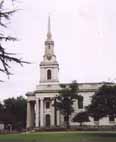
All Saints Church designed by Charles Hollis was built in 1820-3
along with the rectory opposite. The site was purchased from Mrs
Ann Newby (hence Newby Place). The church was repaired in 1951-3
after incurring substantial damage from a V2 rocket during WWII.
The crypt, which had been used as an air raid shelter, was
cleared and converted to a parish centre in 1989. The large
churchyard with Neoclassical railings and granite gatepiers was
made into a public garden in 1865 and relandscaped in 1999 with
Heritage Lottery funding.
Go left along East India Dock
Road
All Saints DLR station was formerly Poplar on the North London
Railway of 1852 which served Blackwall Pier. Poplar Baths (now
closed) were opened in the 1930s. The statue on the frontage is
of George Green, a Blackwall shipbuilder. The fire station was
built on the site of the Bath Street Chapel of 1868. Opposite is
Chrisp Street Market and the Ideas Store (2003). Tower Hamlets
College now occupies the former George Green School of 1883
(founded in 1828).
Go left down Woodstock
Terrace.
The houses were built in the 1850s. The land to the right
was acquired by the East India Company in 1628.
Go through the gate on the
right to view St Matthias old church.
This was originally the Poplar Chapel planned in 1639 but not
built until 1654 (during the Commonwealth). It was under the
control of the East India Dock Company until 1866 when it become
St Matthias Church. It was encased in ragstone by W M Teulon in
1870-6 when the bell tower, porches and chancel were added. It
was closed in 1976 and restored in 1990 by the LDDC for community
use.
At the end of Woodstock
Terrace go right along Poplar High Street.
On the corner the Gothic style building was built in 1869 for the
Poplar District Board of Works. Opposite the Vietnamese Pastoral
Centre was formerly a youth club. Meridian House was the
Chaplin's House for the East India Company's almshouses, designed
in 1801-2 by Henry Holland. The house later served as the
vicarage for St Matthias. Opposite the former Poplar Central
Library of 1894 and School of Marine Engineering & Navigation
of 1902-6 are used by Tower Hamlets College.
Take the entrance into Poplar
Recreation Ground opposite.
This was created by the Poplar Board of Works in 1866.
Follow the path around to the
left and exit into Hale Street. Go to the right along this
street.
Pope John House was built as a seaman's institute in the 1890s by
Sir Arthur Blomfield. It was taken over by the Commercial Gas
Company in the 1930s.
Go left at the end of this
road along East India Dock Road
Number 133 was built as a seaman's home by George Green in
1839-41. Beyond is the Queen Victoria Seaman's Rest.
Left at Wade’s Place
Malam Gardens on the left has cottages provided by the gas
company for its workers. Old gas street lamps remain.
At the end go left along the
High Street then take the path to the right just beyond the
Workhouse towards Poplar DLR station.
The Workhouse leisure centre of 1999 commemorates the Poplar
Workhouse of 1817 (rebuilt 1866). Some of its buildings survived
on the site until 1960.
Go up the steps/lift and use
the footbridge to cross Aspen Way. Go down to street level and
follow the signs to West India Quay station.
The Museum of London Docklands is sited to the right along West
India Quay.
A footbridge from here gives access to Canary Wharf.
© london-footprints.co.uk 2010
Reference sources
Discover London Docklands A-Z Illustrated Guide by S K
Al Naib
Dockland Heritage published by the LDDC
Buildings of England - London 5: East by Cherry, O'Brien &
Pevsner
Trinity Buoy Wharf has a history booklet available on site
[booklist] [places to visit] [historic ships] [public transport] [walks list]