Route & what to see

|
A Bow Walk Route & what to see |
|
london-footprints.co.uk |
A 5 mile walk from Mile End tube station (Central, District and Hammersmith & City lines) to Bromley-by-Bow tube station (District and Hammersmith & City lines). The route can be shortened by finishing at Devons Road DLR station.
Exit Mile End tube station
Opposite is Onyx House by Piers Gough. This replaced a 1938 Odeon
cinema which was built on the site of the 18th century Essex
House. Gough also designed the 'Green Bridge' which allows nearby
Mile End Park to span the main road.
Cross and go right along the
Mile End Road then left into Rhondda Grove
At the end is Holy Trinity Church of 1834-9 by Daniel & James
Austin. Damaged in the Blitz it was closed in 1984. A number of
sea captains are buried in the churchyard which closed in 1853.
Adjacent is the Central Foundation School. This was built in 1909
as Coopers' Company Boys School on the site of Stepney Grammar
School.
Go right along Morgan Street
through Tredegar Square
This was named after the landowner Sir Charles Morgan of
Tredegar. The houses were built in 1828 and the north side
refronted in the 1830s.
Right at Coborn Road
This boundary road was known as Cut Throat Lane before 1800
Left along Mile End Road
St Clement's Hospital was opened as the City of London Union
Workhouse in 1849. It became an infirmary in 1874 and was
expanded as a hospital by the LCC in the 1930s. Some parts were
bomb damaged in WWII. The former Coborn Girls School was built in
1897-8 as a successor to a charity school founded by the will of
Prisca Coborn in 1701. The Central Foundation School moved into
the building from Spital Square in 1975. On the corner with
Harley Grove is a memorial to George Lansbury, twice Mayor of
Poplar and leader of the Labour Party 1931-5. It stands on the
site of his house which was bombed in 1944. On the other corner
are the former offices of Spratts (dog biscuits) used 1939-64.
Go along Harley Grove
Phoenix School stands on the site of Bow Open Air School,
destroyed in WWII. At the end the former chapel of 1854-5 is now
a Sikh Temple (1979) having served as a synagogue from 1927.
Return along Harley Grove and
cross Bow Road into Merchant Street
A metal mile post marker remains. The Methodist Mission building
of 1865 was rebuilt after bomb damage but the Wesley Hall of 1891
remains. On the side of this is a mural called 'Community
Fragments'
Left at Wellington Way
The primary school was opened as an open air school in 1928 by
the LCC. The maternity clinic of 1927 is now a chest clinic.
Wellington Buildings were constructed in 1900-1 to house people
displaced by the railway.
Right at Bow Road
The buildings on the corner of Alfred Street were built in 1924
as electricity showrooms with flats above. There is a memorial
clock to Minnie Lansbury, the daughter-in -law of George
Lansbury. She was imprisoned as a suffragette and a councillor
(see resources) and died aged 32. Bow Road Station was built in
1902. Joseph Westwood, a shipbuilder lived in Tredegar House in
the 1860s/1870s. It was rebuilt in 1911 by Rowland Plumbe as
school for nurses from the London Hospital (closed in the 1970s).
The Police Station on the corner of Addington Road was designed
by John Dixon Butler in 1903 and has stables and married quarters
(added 1930s) to the rear. The Magistrate's Court of 1990
opposite replaced an 1860 courthouse. The bookmakers just beyond
the railway is a former station building (1869) of the Blackwall
extension of the Great Eastern Railway. Beyond Bow Church DLR
Station (opened 1987) is the (haunted) Bow Bells pub. Bromley
Public Hall was built in 1879-80 as the vestry hall for St
Leonards and extended in 1904. Next door is a former police
station of 1859. The Poplar Town Hall opposite was built in
1937-8 by Culpin & Son and replaced Bromley vestry hall.
There are mosaics on the entrance canopy and relief panels
depicting workmen on the corner by David Evans.
Go along Fairfield Road beside
this building
Number 2 was the rectory of 1898. The May Fair was held here
after its removal from the West End in 1764 (replaced by the
school in 1876). The area was developed for housing from the
1820s to 1860s (west side). On the right is the entrance to Grove
Park, originally the grounds of the late 17th century Grove Park
Hall (demolished in 1909). Beyond this is Bow Bus Garage, built
as the LCC's tram depot in 1907-8 and extended in 1910-11. The
Bryant & May match factory was founded in 1860. Warehousing
and offices were constructed in 1874 and the factory built in
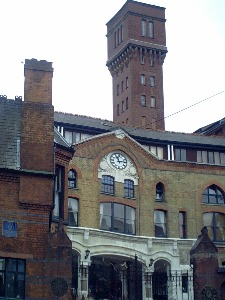
1909-11. The Matchgirls strike was organised by Annie Besant in
1888. Production ceased in 1980 and it has been converted to
luxury apartments and re-named Bow Quarter (sadly now a 'gated
ghetto').
Return to and continue along
Bow Road towards the church.
The present convenience store was built for Stratford Co-op in
1919 (see beehive on pediment). The RC church was originally the
chapel for the convent next door, founded in 1866. The convent
building is now home to the Bow Arts Trust. St Mary's Church was
built as a chapel of ease after 1311 and largely rebuilt in the
1490s. It became a parish church in 1719. Proposals for
rebuilding were shelved for lack of funds until 1896 when the
chancel roof collapsed. The reconstruction was supervised by SPAB
to retain much of the old fabric. C R Ashbee's Guild of
Handicraft provided the metalwork and designs for the new vestry.
It has some interesting memorials and was restored after bomb
damage by Goodhart Rendel. There is a statue to WE Gladstone in
the grounds which was donated by Theodore Bryant.
Cross into Bromley High Street
and go right into Rainhill Way. Opposite the rear of the Register
Office go into the cul-de-sac (Priscilla Road).
The Drapers Almshouses were built in 1706 for 12 poor people with
additions in 1836. The site was purchased by the North London
Railway in 1867 when the east and west wings were demolished. The
remaining buildings which had become derelict were restored by
the GLC and a housing association in 1982 and are now private
houses.
Return to and continue along
Bromley High Street
On the corner of St Leonard's Street is the former Seven Stars
pub, an 1895 replacement of an older building. On the opposite
corner is the memorial gateway to George How, Dean of Stepney
(1840-93). The mid-19th century church of St Mary with St Leonard
(built on the site of a priory) which stood on the site behind
was demolished after war damage. A notice says it is an
'Adventurous Playground' whereas it looks to be an unappealing
wasteground!
Go along St Leonards Street
There is a memorial on Old Palace School to 36 firemen killed in
1941 when the building, which was being used as a sub-station,
received a direct hit. Further along is the Bromley by Bow
Centre, designed by Wyatt MacLaren. New buildings and the former
Congregational church and hall provide community facilities
including a health centre. There are also workshops for
craftspeople and a cafe (open to the public). The 18th century
arch, designed by William Kent, came from Northumberland House.
Go through Bob's Park
This was laid out by the LCC in 1900 on the site of Tudor House.
It has been re-landscaped and includes tiled motifs, made by
local children, in the path. It is named after Robert Grenfield,
a popular park keeper.
Exit into Powis Road and go
right
Kingsley Hall was set up by Muriel & Doris Lester in 1915 to
provide educational and recreational facilities for local people.
During WW1 it maintained a pacifist stance and in 1918 developed
links with the suffragette movement. In 1926 it became a soup
kitchen for families of men involved in the General Strike and in
1936 provided accommodation for the Jarrow Marchers. The present
building was designed by Charles Cowes Voysey and opened in 1928.
It has a plaque to Gandhi who stayed there in 1931 and a new
Peace Garden.
Left into Bruce Road
Houses here were built in the Victorian period (several are
dated). The Children's Nursery (established in 1912) was built in
another building by Voysey in 1923 on the site of stables and
opened by HG Wells (plaque).
Return to and go along Devons
Road
Beyond the railway on the left was St Andrew's Hospital. It
opened in 1871 as the Poplar & Stepney sick asylum, south of
the union workhouse. It was demolished in 2008.
Bear right through the park
and rejoin Devons Road
The site of the park was previously a railway yard. Three pieces
of masonry found during construction have been retained. The
Widow's Son or Bun House pub maintains the tradition of saving
hot cross buns for a son lost at sea.
Beyond the roundabout go right
into Fern Street
The flats have a memorial to Clara Grant who taught at Devons
Road School (since renamed after her). She also opened the Fern
Street Settlement to provide assistance to local people. It was
bombed in WWII but its replacement still serves as a community
centre.
Return to the roundabout.
Either go back to Devons Road DLR Station just beyond the pub or
to continue the walk go right along Violet Road
The Poplar guide of 1927 (see below) describes this road as
having Pratts Motor Spirit Co, Anglo-American Oil Co, council
Electric Light Works, Disinfectant-producing Depot of public
health department, Open Air Swimming Bath and LMS Railway goods
depot. Ahead the former premises of Spratts have now been
converted to housing.
At the Limehouse Cut you need
to go left (eastwards) so go down the steps and walk to the right
(going under the railway).
This is part of the Lea Valley Walk.
Continue along the railed
boardwalk going under the road. Cross over Bow Locks via
the ramp and continue to follow the path between the river and
the canal. Go right onto Three Mills Island.
The House Mill on the left was constructed by Daniel Bisson in
1776 but rebuilt in 1802 following a fire. The Clock Mill on the
right dates from 1753. Ahead the old distillery buildings are now
in use as film studios.
Go back along Three Mills Lane to the Tesco store then left along Hancock Road continuing along the main road. Use the subway to cross to Bromley-by-Bow tube station.
Resources
Tower Hamlets Local History Library and Archives
277 Bancroft Road E1 4DQ. Tel: 020 7364 1290
Buildings of England London 5:
East by Cherry, O'Brien & Pevsner
Bow Road features [webpage]
Bromley-by-Bow features [webpage]
The Lansburys and the Poplar rates revolt [article]
The Matchgirls Strike [article] & [webpage]
St Andrew's Hospital (former Poplar & Stepney sick asylum) [webpage]
Bow Quarter [website]
Bow Road Open Air School [webpage]
© london-footprints.co.uk 2011