
|
THE GREENWICH MERIDIAN |
|
london-footprints.co.uk |
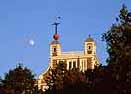
The Royal Observatory at Greenwich was founded in 1675 to observe and record the movement of heavenly bodies in an attempt to solve the longitude problem by the lunar distance method. The observatory building designed by Wren and overseen by Hooke was built on the highest ground in Greenwich Park with rooms for the appointed astronomer, John Flamsteed and an assistant. He worked on the project for over 40 years with his star catalogue being published posthumously in 1725.
Ships at sea could measure latitude by the sun or stars but to determine longitude required time comparison, with an hour's time difference equal to 15° of longitude. The loss of 4 warships and 2000 men under the command of Admiral Sir Cloudsley Shovell off the Scilly Isles in 1707 prompted the passing of the Longitude Act in 1714 offering a huge prize of £20000 for a 'practicable & useful' solution. A sum of £8750 was eventually and reluctantly awarded to the Yorkshire clockmaker, John Harrison who spent 40 years developing his marine chronometer.
A Meridian is just an abstract starting point so ships would use their home port and observatories would set on their own position. Greenwich actually has 4 meridians as successive astronomers - Flamsteed, Halley, Bradley & Airy worked from different points with new equipment. These can be compared in the Meridian Building and Bradleys was adopted by Ordnance Survey. In 1884 at a conference in Washington DC representatives from 25 countries voted to make Greenwich the Prime Meridian of the world as the Nautical Almanacs produced by Nevil Maskelyne, the fifth Astronomer Royal, were the most comprehensive and widely used. The French however retained their Paris Observatory Meridian until 1911.
Greenwich now refers to itself as the 'Centre of Time & Space' and the 'Place where East meets West'. You can find out more by visiting the Royal Observatory (admission charge). You may also like to read the story of John Harrison and his solution to the longitude problem in Dava Sobel's book 'Longitude'. This was made into an excellent TV programme with Michael Gambon and Jeremy Irons which is available on video and DVD.
The Meridian is marked in a number of places in Greenwich.
At the Observatory
In the Meridian building and on its outside wall, in the
courtyard (incorporating a sculpture) and on the path and wall
just outside. A green laser beam is projected from a box above
Airy's transit circle after dark along the line of the meridian
which can reach up to 15 miles.
Southwards
There is a line of stones across the Avenue of the park. The
meridian clips the raised mound covering a reservoir and bisects
the putting green. There should be a stone in the rose beds by
the Ranger's House. The line goes through the dining room,
crimson parlour and gallery of the house itself and is marked on
the outside of the boundary wall (south of the house).
Northwards
You can cross the meridian on the park's Boating Lake! The
Millennium Sundial by the lake is actually wrong by about 8
minutes due to incorrect installation. The diallist is obviously
unhappy about this but it is difficult to see how it could be
rectified. In Park Vista the meridian is marked on the wall of
the Chantry and by a line of studs across the road. The Meridian
School in Old Woolwich Road has a plaque on its wall [website]. The new buildings of Trinity Hospital
(almshouses) opposite have a sundial. The line then runs through
their gardens where it is marked on the path. It passes in front
of the neighbouring power station, across the Thames and is
recorded on the path around the Greenwich Peninsula. Two Meridian
pubs are the Plume of Feathers just to the east in Park Vista and
the Yacht at 00° 00' 06" west in Crane Street.
If anyone knows of any other meridian markers in the London area I would be interested to hear of them and add details to this page. Please use my Guestbook.
Between East India DLR Station and the river a metal strip and compass.
In Halley Gardens off Lee High Road - a plant covered frame topped with a globe. Only the 'west' marker remains and a central plaque is also missing.
There are metal strips in the subway roof under Hither Green Station
Downham Meridian line on oblong stone slab outside number 18 Bromley Hill (dry cleaners). Placed there on 19/5/2002.
There are two markers (a disc and a pillar) in Farnaby Road, Bromley, east of the Ravensbourne River.
An obelisk in Coney Hall Recreation Ground, West Wickham (on the London Loop section 4).
At Glebe School, West Wickham the pupils decorated a 7' stone pillar for the Millennium which stands along with a compass on the Meridian.
From Anna: the meridian runs through Chingford on New Road and through The Scout Association headquarters at Gilwell Park, Chingford.
There is a plaque in the pavement in Sun Street and in the abbey gardens at Waltham Abbey, denoting the path of the Greenwich Meridian.
The Meridian Line is marked by a sundial on the Greenway between Stratford High Street and the Abbey Mills Pumping Station. Also on the footway on the north side of Stratford High Street on the bridge where it crosses the Jubilee line. Time Twist by Malcolm Robertson (1996) in Station Square lies on the meridian.
BOOKS
On the Line by Graham Dolan [website]
Grenwich Meridian Trail [webpage]
Greenwich Time and the Longitude by Derek Howse
(available at National Maritime Museum shops)
© london-footprints.co.uk 2015