|
Westminster Abbey - a survivor |
|
london-footprints.co.uk |
This article is
about how, because of its royal connections and because other
uses were found for the buildings, much of the complex of
Westminster Abbey survives.
Note: There are a number of photo pages for this article.
Click on 'live' numbers within the text below or 'pix' on the key
table of the accompaning map page which locates the
numbered features.
[Introduction] [History] [School] [Exploring] [Visits]
INTRODUCTION
The Reformation in the 1530s brought enormous changes to England.
Henry VIII's desire to divorce Catherine of Aragon, his wife of
24 years, and marry Anne Boleyn, whom he hoped would produce a
male heir, led to a break with the church in Rome and the
establishment of the Church of England, with Henry at its head.
Monasteries, abbeys and priories which had been a large part of
life and landscape would be no more. In some instances the monks
walked out with a pension in others, such as Charterhouse, they
put up a resistance. But the result was the same, the
establishments were closed. Some churches became parish churches,
other buildings were put to secular use. Treasures were
'redistributed' and lands sold or given to royal favourites.
However many buildings were demolished and the materials used
elsewhere. Stones from Merton Priory were used as hardcore in the
foundations of Nonsuch Palace! This destruction affected all
parts of the country including London so that most abbeys etc.
you visit consist of perhaps a church or maybe bits of wall and
stones in the ground marking where buildings once stood. But
Westminster Abbey is different as much of it remains and can be
explored.
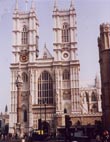
| HISTORY A foundation of Benedictine monks, who first settled around 960, existed on the site in 1042 when Edward the Confessor became king. Nothing remains above ground of the cruciform church he had built and which is depicted in the Bayeux Tapestry. In 1245 Henry III began rebuilding the abbey but after his death in 1272 worked largely stopped until the reign of Richard II. Henry V financed more work and Henry VII was responsible for the new chapel at the east end, completed in 1519. In January 1540 the monastery was dissolved and became the cathedral of the new diocese of Westminster. The abbot became the first Dean and the prior and other monks served as clergy. The religious order was restored 1556-60 by Queen Mary. Sir Christopher Wren was surveyor 1698-1723 undertaking restoration work whilst Nicholas Hawksmoor designed the west towers, completed in 1745. |
|
|
WESTMINSTER
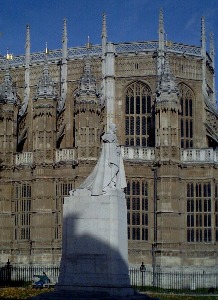
SCHOOL This began as a school for clerks provided by the monks of the abbey. Initially it was held in the almonry building, moving to east Dean's Yard in 1461. At the dissolution the school was given the abbot's dining room, the granary building (used as a dormitory until the 1720s) and the monk's dormitory, for use as a classroom. The whole school was taught in this room between 1602 and 1884. Elizabeth I refounded the school in 1560 when fee-paying boys were admitted. A new statue of Queen Elizabeth I by Matthew Spender was commissioned for the 450th anniversary of the school and unveiled by the Queen (visible from College Garden). The Public School Act of 1868 made it financially and administratively independant of the abbey and a board replaced the Dean and Chapter. It was given legal possession of its buildings with the exception of College Hall. |
EXPLORING THE ABBEY The abbey was built on Thorney Island, isolated by tributaries of the River Tyburn. Ditches fed by the river defined the precinct boundaries and followed the line of present Great College Street as well as forming a moat around the Jewel Tower [1]. The precinct was also walled and parts of the 14thc wall remain to the south and east (view from Abingdon Street or Great College Street). There were gates on all sides. The Great Gate which led to the north transcept of the abbey church has gone but a south entrance from Tufton Street remains. On the east, where now stands a statue of George V was a postern gate [3]. On the west, sited near the memorial to scholars of Westminster School killed in the Crimea, was a gatehouse [4] which incorporated a prison from the 14thc until its demolition in 1776. Just outside this gate was the almonry which distributed to the needy. The abbey traditionally provided sanctuary within its walls (until the 17thc) and the present street names record this. The grassed area to the north of the abbey nave was the churchyard [5] which was cleared in the 19thc and the site of the sacristy. St Margaret's Church [6] was founded by the abbot in the mid 12thc but demolished in the reign of Edward III. It was rebuilt 1486-1523 but has been restored many times since. It serves as the parish church for the present House of Commons (see visits). |
|
|
There is much to see in the abbey itself [7] (see visits).
Dean's Yard [8], now a playing field for the school, was
the site of the abbey farm which included a mill,
bakehouse, brewhouse and a granary to the south east. On
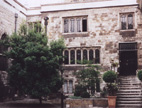
the east side were the guest house [12] and cellarers [10] (1388-91)
buildings, now part of Westminster School. The south
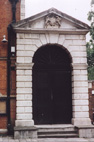
entrance [11] leads into Little Dean's Yard
and the north entrance, with the Blackstone Tower above,
would have given access to the monk's kitchen. On the
north side is the kitchen associated with the former
Abbot's House [42]. Entering by the gate at the north
east into the Parlour [13] Deanery Courtyard [41]
(private) is to the left. On the left hand side is
College Hall [14] of 1376, the school dining room,
formerly used by the abbot who lived on the opposite
side, now the Deanery [15]. Up the steps ahead are two
small rooms - the 16thc Jericho Parlour [16] and the
Jerusalem Chamber [17] of the 1370s where Henry IV died.
This can be viewed from the Sanctuary (behind the abbey
shop). |
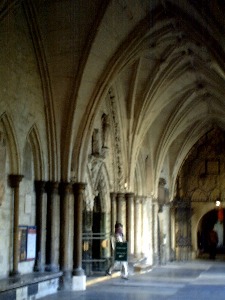
| The cloisters [18] provided covered walkways but also areas in which to work. The oldest part is in the NE where there is a door into the abbey. There are some stone coffins in the NW corner. The west walk [19] was the site of the monk's school with a washing area (lavatorium) at the southern end, now the site of a memorial to the Indian civil service [20]. A corbel featuring a figure remains on the right. The north walk [21], which now has a refreshment area and shop, had the best light for working. At the western end playing boards for games such as Nine Man Morris have been made in the stone seat. The south walk was the place of 8 early abbot burials [22], of which 3 effigies can still be seen. Behind the south walk would have been the refectory where the monks took their meals. This was largely demolished by 1544 although a section of wall is visible above the south walk. It was replaced with the buildings of the song school [23] and the gardens of Ashburnham House. The song school still retains the old doorway and to the left four recesses used to store towels [24] were replicated in 1970. |
|
|
The east walk [25] gives access to several buildings and had presses for book storage. The octagonal Chapter House [26] (built in 1245-55) was so called because a chapter from the rules of St Benedict was read when the monks used it for their meetings. It was retained by the crown at the Dissolution and used by the House of Commons until 1547. It housed public records until 1866 and was then restored by Sir George Gilbert Scott (completed 1873). The stained glass was replaced following WWII damage and later restoration was undertaken by English Heritage. Its crypt is accessed from the abbey. At the southern end of the south transept of the abbey is St Faith's Chapel [27] with a door and windows onto the vestibule of the Chapter House. On the opposite side of the vestibule is Englands oldest door? (c1050). To the right of the entrance to the Chapter House is a door [28] to what would originally have been the monk's day stairs. They now give access to the muniment room and library (c1620). This and the adjoining schoolroom occupy what would have been the monk's sleeping quarters (dormitory). The schoolroom section of the roof had to be replaced after WWII bomb damage. It features a lantern and a phoenix. The night stairs would have taken the monks across the galley of St Faith's Chapel and down into the SW corner of the abbey's south transept. |
The Pyx Chamber [29] contained the abbey's valuables and sacred relics and later a box with standard pieces of gold and silver. Until the late 12th century it was part of the undercroft. Notice the strong double doors. The southern extension of the east walk is the Dark Cloister [30] with access to the undercroft [31]. This 11thc room was the monk's common room but now serves as a museum (opened 1908) whose displays include wax effigies. A barrel-vaulted passageway [32] of 1065-75 leads into Little Cloister [33]. This would have been the infirmary area for old and sick monks. There was originally an infirmary hall to the SE but later the monks occupied individual chambers around the cloister. They would have used St Catherine's Chapel [34] (c1160) on the east side, the ruins of which are visible. There is a statue of St Catherine on the post-war buildings to the north. To the south of Little Cloister was a lavatory block (reredorter). The site is now covered with school buildings [44] but parts of its east wall remain. A few tiles can be seen above a window in the SW corner. Between Little Cloister and the Chapter House was the monk's cemetery [36], now the site of St Dunstan's Chapel and the school gymnasium. |
|
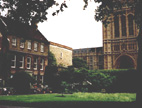 |
The south east corner of Little Cloister gives access to College Garden [37] where fruit and vegetables, along with medicinal plants, would have been cultivated for the use of the infirmarer. It also served as an area for monks to relax and exercise and after the Dissolution it was used by the clergy. In recent years an attempt has been made to acknowledge the garden's original use by planting vegetables, herbs and fruit trees. The building to the west is a dormitory for the school [38]. The original was designed by Wren and altered by Lord Burlington in 1734 but reconstructed after WWII bomb damage. To the north of this building is a gate giving a view into Little Dean's Yard [39] (school property). Ashburnham House [40] to the right, built in the 1660s, incorporates elements of two earlier houses occupied by medieval priors. |
VISITS
Parts may be closed for special services and occasions [check website]
The abbey itself is generally open Monday - Friday 9:30-4:30,
Wednesday 9:30-7pm & Saturday 9:30-3:30. Last admission is
one hour prior to these times.
It is only open for services on Sundays (visitors welcome)
There is a charge for admission which includes an audio guide.
The Chapter House, Pyx Chamber and museum are included in
admission. The Chapter House and museum are open daily 10:30-4.
The Pyx Chamber is open Monday - Saturday 10:30-3:30. English
Heritage members can visit the Chapter House & Pyx chamber
free of charge.
Verger tours are available (additional charge).
The cloisters are open daily 8am - 6pm
College Garden is open Tuesday - Thursday 10am-4pm (Oct-Mch) or
6pm (Apl - Sept). Donation invited. Guide leaflet available.
Parts of Little Cloister including St Catherine's Chapel remains
can be viewed when College Garden is open
The library is open Monday - Friday 10-1 & 2-4:45 by
appointment for research.
St Margaret's Church is open Monday - Friday 9:30-3:30, Saturday
9:30-1:30 & Sunday 2-4:45. Donation invited.
RESOURCES
Visit the abbey website for detailed information
on all aspects of the abbey.
The Abbey Shop (situated near the west entrance) is open from
9:15 until at least 5pm Monday - Saturday and 11:30-5:30 Sunday
Buildings of England: London 6 - Westminster by Bradley &
Pevsner
The Wikipedia article on Westminster School.
Play Nine Man Morris [instructions]
© london-footprints.co.uk 2010